
A coastlineor seashore is the area where land meets the sea or ocean. A precise line that can be called a coastline cannot be determined due to the dynamic nature of tides. The term "coastal zone" can be used instead, which is a spatial zone where interaction of the sea and land processes occurs. Both the terms coast and coastal are often used to describe a geographic location or region; for example, New Zealand's West Coast, or the East and West Coasts of the United States.
A pelagic coast refers to a coast which fronts the open ocean, as opposed to a more sheltered coast in a gulf or bay. A shore, on the other hand, can refer to parts of the land which adjoin any large body of water, including oceans (sea shore) and lakes (lake shore). Similarly, the somewhat related term "bank" refers to the land alongside or sloping down to a river (riverbank) or to a body of water smaller than a lake. "Bank" is also used in some parts of the world to refer to an artificial ridge of earth intended to retain the water of a river or pond. In other places this may be called a levee.
While many scientific experts might agree on a common definition of the term "coast", the delineation of the extents of a coast differ according to jurisdiction, with many scientific and government authorities in various countries differing for economic and social policy reasons.
Formation
Atlantic rocky coastline, showing a surf area. Porto Covo, west coast of Portugal
Tides often determine the range over which sediment is deposited or eroded. Areas with high tidal ranges allow waves to reach farther up the shore, and areas with lower tidal ranges produce deprossosition at a smaller elevation interval. The tidal range is influenced by the size and shape of the coastline. Tides do not typically cause erosion by themselves; however, tidal bores can erode as the waves surge up river estuaries from the ocean.
Waves erode coastline as they break on shore releasing their energy; the larger the wave the more energy it releases and the more sediment it moves. Coastlines with longer shores have more room for the waves to disperse their energy, while coasts with cliffs and short shore faces give little room for the wave energy to be dispersed. In these areas the wave energy breaking against the cliffs is higher, and air and water are compressed into cracks in the rock, forcing the rock apart, breaking it down. Sediment deposited by waves comes from eroded cliff faces and is moved along the coastline by the waves. This forms an abrasion or cliffed coast.
Sediment deposited by rivers is the dominant influence on the amount of sediment located on a coastline. Today riverine deposition at the coast is often blocked by dams and other human regulatory devices, which remove the sediment from the stream by causing it to be deposited inland.
Like the ocean which shapes them, coasts are a dynamic environment with constant change. The Earth's natural processes, particularly sea level rises, waves and various weather phenomena, have resulted in the erosion, accretion and reshaping of coasts as well as flooding and creation of continental shelves and drowned river valleys (rias).
Environmental importance
The coast and its adjacent areas on and off shore are an important part of a local ecosystem: the mixture of fresh water and salt water in estuaries provides many nutrients for marine life. Salt marshes and beaches also support a diversity of plants, animals, and insects crucial to the food chain.
The high level of biodiversity creates a high level of biological activity, which has attracted human activity for thousands of years.
Human impacts
Human uses of coasts

A settled coastline in Marblehead, Massachusetts. Once a fishing port, the harbor is now dedicated to tourism and pleasure boating. Observe that the sand and rocks have been darkened by oil slick up to the high-water line.

This stretch of coast in Tanzania's capital Dar es Salaam serves as a public waste dump.
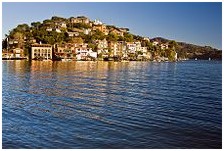
Houses close to the coast, like these in Tiburon, California, may be especially desirable properties.

View of sea coast from top of a hill at Visakhapatnam in India
More and more of the world's people live in coastal regions. Many major cities are on or near good harbors and have port facilities. Some landlocked places have achieved port status by building canals.
The coast is a frontier that nations have typically defended against military invaders, smugglers and illegal migrants. Fixed Coastal defenses have long been erected in many nations and coastal countries typically have a navy and some form of coast guard.
Coasts, especially those with beaches and warm water, attract tourists. In many island nations such as those of the Mediterranean, South Pacific and Caribbean, tourism is central to the economy. Coasts offer recreational activities such as swimming, fishing, surfing, boating, and sunbathing. Growth management can be a challenge for coastal local authorities who often struggle to provide the infrastructure required by new residents.
Threats to a coast
Coasts also face many human-induced environmental impacts. The human influence on climate change is thought to contribute to an accelerated trend in sea level rise which threatens coastal habitats.
Pollution can occur from a number of sources: garbage and industrial debris; the transportation of petroleum in tankers, increasing the probability of large oil spills; small oil spills created by large and small vessels, which flush bilge water into the ocean.
Fishing has declined due to habitat degradation, overfishing, trawling, bycatch and climate change. Since the growth of global fishing enterprises after the 1950s, intensive fishing has spread from a few concentrated areas to encompass nearly all fisheries. The scraping of the ocean floor in bottom dragging is devastating to coral, sponges and other long-lived species that do not recover quickly. This destruction alters the functioning of the ecosystem and can permanently alter species composition and biodiversity. Bycatch, the capture of unintended species in the course of fishing, is typically returned the ocean only to die from injuries or exposure. Bycatch represents about a quarter of all marine catch. In the case of shrimp capture, the bycatch is five times larger than the shrimp caught.
It is believed that melting Arctic ice will cause sea levels to rise and flood costal areas.
Conservation
Extraordinary population growth in the 20th century has placed stress on the planet's ecosystems. For example, on Saint Lucia, harvesting mangrove for timber and clearing for fishing reduced the mangrove forests, resulting in a loss of habitat and spawning grounds for marine life that was unique to the area. These forests also helped to stabilize the coastline. Conservation efforts since the 1980s have partially restored the ecosystem.
Types of coast
According to one principle of classification, an emergent coastline is a coastline which has experienced a fall in sea level, because of either a global sea level change, or local uplift. Emergent coastlines are identifiable by the coastal landforms, which are above the high tide mark, such as raised beaches. In contrast, a submergent coastline is one where the sea level has risen, due to a global sea level change, local subsidence, or isostatic rebound. Submergent coastlines are identifiable by their submerged, or "drowned" landforms, such as rias (drowned valleys) and fjords.
According to a second principle of classification, a concordant coastline is a coastline where bands of different rock types run parallel to the shore. These rock types are usually of varying resistance, so the coastline forms distinctive landforms, such as coves. Discordant coastlines feature distinctive landforms because the rocks are eroded by ocean waves. The less resistant rocks erode faster, creating inlets or bays; the more resistant rocks erode more slowly, remaining as headlands or outcroppings.
Other coastal categories:
- A cliffed coast or abrasion coast is one where marine action has produced steep declivities known as cliffs.
- A flat coast is one where the land gradually descends into the sea.
- A graded shoreline is one where wind and water action has produced a flat and straight coastline.
Coastal landforms

Coastal landforms. The feature shown here as a bay would, in certain (mainly southern) parts of Britain, be called a cove. That between the cuspate foreland and the tombolo is a British bay.
Cliff erosion
- Much of the sediment deposited along a coast is the result of erosion of a surrounding cliff, or bluff. Sea cliffs retreat landward because of the constant undercutting of slopes by waves. If the slope/cliff being undercut is made of unconsolidated sediment it will erode at a much faster rate then a cliff made of bedrock. (Easterbrook 1999).
- A Natural arch is formed when a sea stacks is eroded through by waves.
- Sea caves are made when certain rock beds are more susceptible to erosion than the surrounding rock beds because of different areas of weakness. These areas are eroded at a faster pace creating a hole or crevasse that, through time, by means of wave action and erosion, becomes a cave.
- A Stack is formed when a headland is eroded away by wave and wind action.
- A Stump is a shortened sea stack that has been eroded away or fallen because of instability.
- Wave-cut notches are caused by the undercutting of overhanging slopes which leads to increased stress on cliff material and a greater probability that the slope material will fall. The fallen debris accumulates at the bottom of the cliff and is eventually removed by waves.
- A wave-cut platform forms after erosion and retreat of a sea cliff has been occurring for a long time. Gently sloping wave-cut platforms develop early on in the first stages of cliff retreat. Later the length of the platform decreases because the waves lose their energy as they break further off shore (Easterbrook 1999).
Animals
A wide variety of animals live along a typical coast. Some birds nest there, like puffins, sea turtles and rockhopper penguins. Sea snails and various kinds of barnacles live on the coast and scavenge on food deposited by the sea. Most coastal animals are used to humans in developed areas, such as dolphins and seagulls who eat food thrown for them by tourists. Since the coastal areas are all part of the littoral zone, there is a profusion of marine life found just off-coast.
There are many kinds of seabirds on the coast. Pelicans and cormorants join up with terns and oystercatchers to forage for fish and shellfish on the coast. There are sea lions on the coast of Wales and other countries.
Plants
Coastal areas are famous for their kelp beds. Kelp is a fast growing seaweed that grows up to a metre a day. Corals and anemones are true animals, but live a similar lifestyle as plants do. Mangroves, Seagrasses and salt marsh are important coastal vegetation types in tropical and temperate environments respectively.
Coastline statistics
Coastline problem
Shortly before 1951, Lewis Fry Richardson, in researching the possible effect of border lengths on the probability of war, noticed that the Portuguese reported their measured border with Spain to be 987 km, but the Spanish reported it as 1214 km. This was the beginning of the coastline problem, which is a mathematical uncertainly inherent in the measurement of boundaries that are irregular.
The prevailing method of estimating the length of a border (or coastline) was to lay out n equal straight-line segments of length ℓ with dividers on a map or aerial photograph. Each end of the segment must be on the boundary. Investigating the discrepancies in border estimation, Richardson discovered what is now termed the Richardson Effect: the sum of the segments is inversely proportional to the common length of the segments. In effect, the shorter the ruler, the longer the measured border; thus, the Spanish and Portuguese geographers were using different-length rulers.
The result most astounding to Richardson is that, under certain circumstances, as ℓapproaches zero, the length of the coastline approaches infinity. Richardson had believed, based on Euclidean geometry, that a coastline would approach a fixed length, as do similar estimations of regular geometric figures. For example, the perimeter of a regular polygon inscribed in a circle approaches the circumference with increasing numbers of sides (and decrease in the length of one side). In Geometric measure theory such a smooth curve as the circle that can be approximated by small straight segments with a definite limit is termed a rectifiable curve.
Measuring a coastline
More than a decade after Richardson completed his work, Benoît Mandelbrot developed a new branch of mathematics, fractal geometry, to describe just such non-rectifiable complexes in nature as the infinite coastline. His own definition of the new figure serving as the basis for his study is:
I coined fractalfrom the Latin adjective fractus. The corresponding Latin verb frangeremeans "to break:" to create irregular fragments. It is therefore sensible ... that, in addition to "fragmented" ... fractusshould also mean "irregular."
A key property of the fractal is self-similarity; that is, at any scale the same general configuration appears. A coastline is perceived as bays alternating with promontories. In the hypothetical situation that a given coastline has this property of self-similarity, then no matter how greatly any one small section of coastline is magnified, a similar pattern of smaller bays and promontories superimposed on larger bays and promontories appears, right down to the grains of sand. At that scale the coastline appears as a momentarily shifting, potentially infinitely long thread with a stochastic arrangement of bays and promontories formed from the small objects at hand. In such an environment (as opposed to smooth curves) Mandelbrot asserts "coastline length turns out to be an elusive notion that slips between the fingers of those who want to grasp it."
There are different kinds of fractals. A coastline with the stated property is in "a first category of fractals, namely curves whose fractal dimension is greater than 1." That last statement represents an extension by Mandelbrot of Richardson's thought. Mandelbrot's statement of the Richardson Effect is:

where L, coastline length, a function of the measurement unit, ε, is approximated by the expression. F is a constant and D is a parameter that Richardson found depended on the coastline approximated by L. He gave no theoretical explanation but Mandelbrot identified D with a non-integer form of the Hausdorff dimension, later the fractal dimension. Rearranging the right side of the expression obtains:

where Fε-Dmust be the number of units ε required to obtain L. The fractal dimension is the number of the dimensions of the figure being used to approximate the fractal: 0 for a dot, 1 for a line, 2 for a square. D in the expression is between 1 and 2, for coastlines typically less than 1.5. The broken line measuring the coast does not extend in one direction nor does it represent an area, but is intermediate. It can be interpreted as a thick line or band of width 2ε. More broken coastlines have greater D and therefore L is longer for the same ε. Mandelbrot showed that D is independent of ε.
Source :
http://en.wikipedia.org/wiki/Coast


